

How Currency Fluctuations Could Impact Dubai’s Real Estate Market in the 2026–27 Financial Year
With data-backed insights across INR, HKD, JPY, USD, EUR & GBP
Dubai enters the 2026–27 financial year with strong transaction activity, expanding supply, and rising global investor interest. However, one factor will shape foreign buying power more than anything else: currency fluctuations.
Because the UAE dirham (AED) is pegged to the US Dollar (USD) at 3.6725, any movement in other currencies relative to the USD directly affects what buyers from India, Europe, Japan, Hong Kong, or the UK can afford.
This article explores how major currency moves could influence Dubai’s real estate market — backed by public forecasts, central bank data, and recent FX trends.
Why Currencies Matter for Dubai Property
- The AED–USD Peg
The AED has been effectively fixed at 1 USD = 3.6725 AED for decades according to the Central Bank of the UAE.
This means:
UAE interest rates closely follow the US Federal Reserve.
Foreign buyer affordability depends on how their home currency behaves against the USD.
2. Two Direct Market Channels
A. Affordability Channel
Buyers converting their home currency into AED face different prices depending on FX swings.
A 5–10% move in the exchange rate can change the real cost of a property by tens of thousands of dollars.
B. Liquidity & Funding Channel
Since UAE rates track US policy, periods of strong USD and high US rates increase:
- Dubai mortgage rates
- Developer financing costs
- Pressure on global liquidity
A softer USD creates the opposite: cheaper funding and greater investor appetite.
How Each Major Currency Could Affect Dubai in 2026–27
Below is an analysis of each currency based on late-2025 forecasts, economic reports, and observed volatility.
Indian Rupee (INR)
Why it matters: Indians are consistently among Dubai’s top 3 buyer nationalities.
Trend: The INR showed bouts of weakness through 2025, with analysts citing trade deficit pressure and capital outflow risks (Reuters, 2025).
Impact on 2026–27
If INR weakens:
- Dubai becomes more expensive for NRI families and investors.
- Demand may shift toward smaller/affordable units.
- Developers may offer INR-friendly payment plans or lower down payments.
If INR strengthens:
- Expect a surge in NRI buying across mid-market communities and new launches.
Hong Kong Dollar (HKD)
Why it matters: HK investors consistently target Dubai prime assets.
Trend: HKD is pegged to the USD within a tight band. Forecasts expect stability, but liquidity sentiment depends heavily on China’s macro performance.
Impact on 2026–27
Stable HKD:
- Predictable buying activity in premium segments.
If Hong Kong faces liquidity stress:
- Prime purchases could soften temporarily as investors derisk.
Japanese Yen (JPY)
Why it matters: Japanese UHNW and institutional capital continue diversifying abroad.
Trend: The yen has been extremely volatile since 2022 due to Bank of Japan policy changes and global rate gaps.
Impact on 2026–27
Weak JPY:
- Dubai becomes costlier in yen terms.
- Retail and second-home interest declines.
Stronger JPY:
- Dubai may attract more Japanese buyers.
- Institutional capital could increase allocation to USD-linked assets.
US Dollar (USD)
Why it matters: The AED follows the USD.
2026–27 Dubai market conditions will mirror the USD’s strength and the Fed’s policy path.
Trend: Late-2025 forecasts (ING, Bloomberg) suggest moderate USD cooling through 2026 as inflation stabilizes.
Impact on 2026–27
Strong USD:
- Foreign buyers from Europe and Asia feel the affordability squeeze.
- Dubai mortgage rates stay elevated.
- GCC income buyers dominate.
Softening USD:
- Foreign affordability improves.
- Global liquidity returns.
- Transaction volumes rise.
Euro (EUR) & British Pound (GBP)
Why it matters: Europe is one of Dubai’s largest inbound buyer regions.
Trend: The Euro showed mild recovery signs in late-2025. The Pound exhibited relative strength based on UK GDP data.
Impact on 2026–27
If EUR/GBP weaken:
- Europeans may delay holiday-home purchases.
- Demand becomes more price sensitive.
If EUR/GBP strengthen:
- Strong inflow into Dubai’s villa and beachfront segments.
- Increased competition for prime properties.
2026–27 Scenarios
Scenario 1 — USD Softens, Asian Currencies Strengthen (Bullish Case)
NRIs, Europeans, and Japanese buyers regain purchasing power.
Dubai sees higher transaction volumes and price appreciation.
Scenario 2 — USD Stays Strong, INR & JPY Weaken (Neutral/Pressure Case)
Europe & Asia face affordability pressure.
Developers rely more on GCC & USD-income buyers.
Payment plans become aggressive again.
Scenario 3 — Global Risk-Off Shock (Bearish Case)
Even with favorable FX, high global uncertainty reduces investment flows.
Prime assets remain stable; speculative off-plan slows.
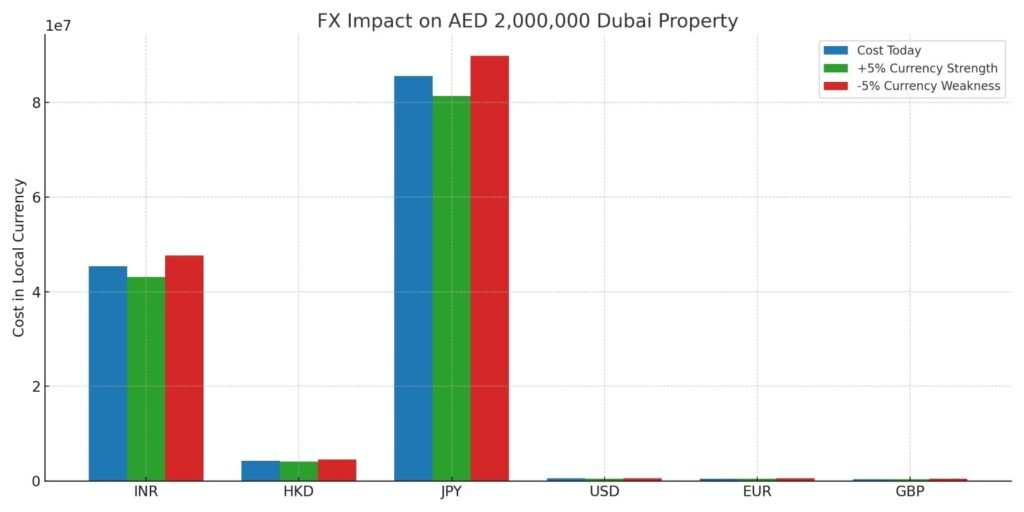
Interpretation:
A 5% change in INR alters the real cost by nearly ₹2.27 crore (~AED 100k).
A 5% JPY swing shifts Japanese cost by ¥4.28 million.
For European buyers, a modest 5% move can change affordability by €25k+.
Conclusion
Currency movements will play a central role in shaping Dubai’s real estate demand in 2026–27.
A strengthening USD generally pressures buyers from INR, JPY, EUR, GBP markets, whereas a softer USD releases pent-up global demand.
Buyers, brokers, and developers should monitor FX trends closely — even small swings materially change affordability in a market priced in USD/AED.